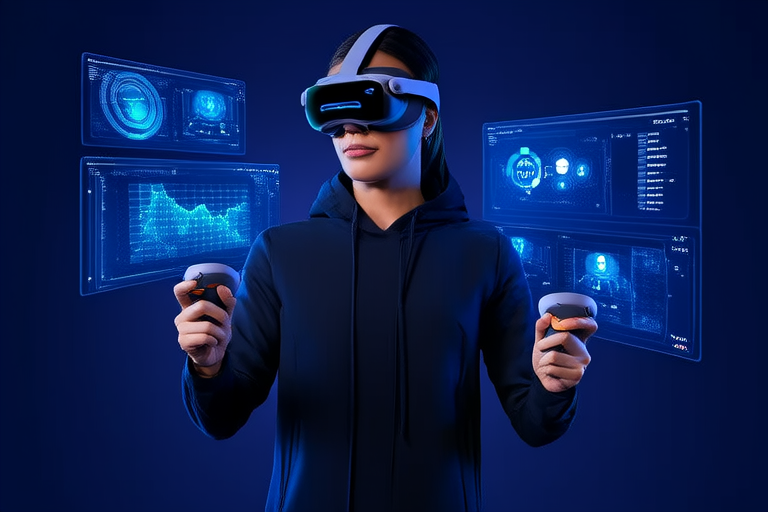

Virtual Frontiers: Navigating the Evolution of VR and AR
Introduction
Virtual Reality (VR) and Augmented Reality (AR) have emerged as transformative technologies that offer immersive experiences, blurring the lines between the physical and digital worlds. VR immerses users completely in a computer-generated environment, whereas AR overlays digital information onto the real world, enhancing it with interactive elements. Both technologies have come a long way since their inception, evolving from experimental prototypes to widely adopted tools across various sectors.
Over the years, VR and AR have developed distinct yet complementary capabilities. While VR provides a fully immersive experience, cutting off all external stimuli, AR enhances reality by integrating virtual objects seamlessly into the user’s surroundings. This distinction has led to diverse applications, from gaming and entertainment to education, healthcare, and industrial training.
Historical Context
The origins of VR can be traced back to the 1960s, when Ivan Sutherland created the first head-mounted display system called the “Sword of Damocles.” This groundbreaking invention laid the foundation for modern VR systems. In the following decades, VR technology saw gradual advancements, with notable contributions from companies like VPL Research, which introduced the Data Glove and EyePhone in the late 1980s. These early devices were bulky and expensive, limiting their widespread adoption.
AR also has its roots in the 1960s, with Morton Heilig’s Sensorama, which provided multi-sensory experiences. However, significant progress in AR began in the 1990s with the development of head-up displays for military aircraft. Later, companies like Google and Microsoft made substantial contributions, with Google Glass and Microsoft HoloLens becoming prominent examples of consumer-facing AR devices. These advancements have paved the way for more sophisticated and accessible AR solutions.
Current State of VR and AR
Today, VR and AR technologies are more advanced than ever before, offering a range of innovative applications. In the gaming sector, VR has become a cornerstone, providing players with immersive experiences through platforms like Oculus Rift and HTC Vive. Meanwhile, AR games like Pokémon Go have captivated millions, blending the real and virtual worlds.
Beyond entertainment, VR and AR are revolutionizing healthcare, enabling medical professionals to conduct surgeries remotely and train students in realistic simulations. Education benefits from these technologies too, with virtual classrooms and interactive learning modules enhancing student engagement. Manufacturing industries are leveraging AR for maintenance and repair tasks, overlaying digital instructions directly onto machinery.
Key players in the market include Oculus, HTC, Sony, and Valve in VR, alongside Microsoft, Apple, and Magic Leap in AR. Products such as the Oculus Quest 2 and Microsoft HoloLens 2 exemplify the cutting-edge capabilities available today.
Challenges and Limitations
Despite significant progress, VR and AR face several challenges. Technical barriers include high costs, limited resolution, and latency issues, which can detract from user experience. Additionally, the need for powerful hardware and software poses accessibility problems, particularly for less affluent consumers.
User experience issues often arise from discomfort, motion sickness, and inadequate interaction methods. Ensuring seamless integration between virtual and real environments remains a complex task. Ethical concerns also surface, particularly regarding data privacy, user consent, and the potential for misuse in surveillance or manipulation.
Companies and researchers are actively working to address these challenges. Innovations in haptic feedback, eye-tracking, and AI-driven interfaces aim to enhance user comfort and interaction. Improved algorithms and better hardware design are reducing latency and increasing resolution. Furthermore, ethical guidelines and regulations are being developed to protect user rights and ensure responsible use of these technologies.
Future Prospects
The future of VR and AR holds immense promise, with ongoing advancements set to further integrate these technologies into everyday life. Emerging trends include the development of mixed reality (MR), which combines features of both VR and AR, offering users more flexible and versatile experiences. Advancements in hardware, such as lighter and more comfortable headsets, will make these technologies more accessible.
Breakthroughs in software, including AI-driven content generation and personalized experiences, will enhance immersion and interactivity. Enhanced connectivity through 5G networks will enable real-time collaboration and remote participation in virtual environments. These developments could transform industries, from remote work and telemedicine to social interactions and cultural events.
As VR and AR continue to evolve, they have the potential to redefine human interaction, opening up new possibilities for communication, learning, and entertainment. The seamless blending of digital and physical worlds could lead to unprecedented levels of productivity, creativity, and social connection.
Conclusion
From humble beginnings as experimental technologies, VR and AR have grown into powerful tools capable of reshaping numerous aspects of our lives. Their evolution from bulky, expensive prototypes to sophisticated, accessible devices reflects remarkable progress. While challenges remain, ongoing innovation and collaborative efforts are addressing these hurdles, paving the way for even greater advancements.
As we look to the future, the potential for VR and AR to transform society is vast. By enhancing our ability to interact with digital environments and each other, these technologies hold the promise of creating more connected, efficient, and engaging experiences. The journey ahead promises exciting developments, and it will be fascinating to witness how VR and AR continue to evolve and impact our world.