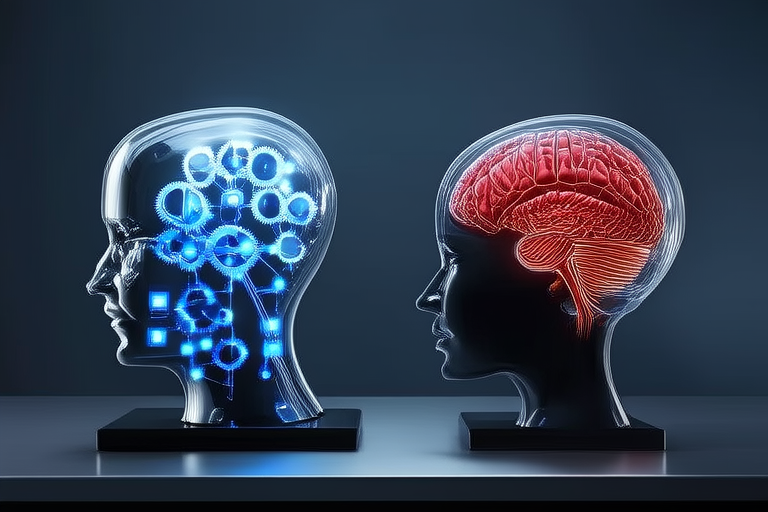

Machine Learning vs. Deep Learning: Understanding the Differences
Introduction
In today’s rapidly evolving technological landscape, artificial intelligence (AI) plays an increasingly critical role in shaping our world. At the heart of AI lies two pivotal subsets: machine learning (ML) and deep learning (DL). These techniques have revolutionized industries ranging from healthcare to finance, enabling computers to learn from data and make decisions with minimal human intervention.
Machine learning refers to the process by which systems automatically improve through experience and by the detection of patterns. It encompasses a broad range of algorithms that can be used to solve various problems. On the other hand, deep learning represents a subset of machine learning that uses multi-layered neural networks to simulate the way humans learn, thereby achieving superior performance in certain tasks.
What is Machine Learning?
Definition and Basic Principles
Machine learning is a branch of AI focused on developing algorithms that enable computers to learn from and make predictions based on data. Rather than being explicitly programmed to perform specific tasks, these algorithms learn from past experiences (i.e., historical data), identify patterns, and apply those insights to new situations.
Common Algorithms Used
- Decision Trees: A tree-like model of decisions and their possible consequences, often used for classification and regression tasks.
- Support Vector Machines (SVM): A supervised learning model used for classification and regression analysis.
- K-Nearest Neighbors (KNN): A simple, instance-based learning algorithm that classifies objects based on closest training examples in the feature space.
- Random Forest: An ensemble method that builds multiple decision trees and merges them together to get a more accurate and stable prediction.
Applications and Real-World Examples
Machine learning has found applications across numerous domains. For example:
- Healthcare: Predictive modeling for disease diagnosis and treatment recommendations.
- Finance: Fraud detection, credit scoring, and algorithmic trading.
- Retail: Personalized marketing and customer segmentation.
- Manufacturing: Quality control and predictive maintenance.
What is Deep Learning?
Definition and Explanation
Deep learning is a specialized form of machine learning that leverages artificial neural networks composed of many layers to model complex patterns within data. Unlike traditional ML approaches, deep learning does not require extensive feature engineering; instead, it automatically discovers relevant features from raw data through hierarchical processing.
Key Components of Deep Learning
- Neural Networks: A set of algorithms designed to recognize patterns and mimic the structure of the human brain.
- Layers: Different levels within a neural network responsible for different aspects of pattern recognition.
- Activation Functions: Mathematical functions that introduce non-linearity into the model, allowing it to learn complex relationships.
Popular Architectures
- Convolutional Neural Networks (CNNs): Primarily used for image and video recognition.
- Recurrent Neural Networks (RNNs): Suitable for sequential data such as time series or natural language processing.
- Transformers: Recently gaining popularity due to their effectiveness in handling large-scale text data.
Comparison of Machine Learning and Deep Learning
Data Requirements
One significant difference between ML and DL lies in their data requirements. Traditional machine learning models generally perform well with moderate amounts of labeled data, whereas deep learning models tend to require vast datasets to achieve optimal performance. This is because deep learning relies heavily on the ability to generalize from large quantities of information.
Computational Resources
Another key distinction is the computational power needed for each approach. Training deep learning models often demands powerful GPUs (Graphics Processing Units) and specialized software frameworks, while conventional ML algorithms can run efficiently on standard CPUs with less advanced tools.
Complexity of Models
The complexity involved in constructing and fine-tuning models also varies. Building a successful deep learning system typically requires more expertise and experimentation compared to simpler ML methods. However, once trained, deep learning models may offer greater accuracy and robustness.
Performance
When deciding whether to employ ML or DL, consider the nature of your task. If you’re dealing with structured data like tabular information, traditional ML might suffice. Conversely, unstructured data such as images, audio, or text benefits significantly from deep learning techniques.
Applications
Machine Learning
Industries where machine learning shines include:
- Customer Service: Chatbots powered by natural language processing (NLP).
- Supply Chain Management: Demand forecasting and inventory optimization.
- Human Resources: Recruitment analytics and employee retention strategies.
Deep Learning
Fields where deep learning excels encompass:
- Autonomous Vehicles: Object detection and scene understanding.
- Medical Imaging: Disease identification via radiology scans.
- Speech Recognition: Voice assistants and transcription services.
Conclusion
To summarize, both machine learning and deep learning serve essential roles within the realm of artificial intelligence, albeit suited to different types of challenges. While machine learning offers flexibility and efficiency for structured data, deep learning excels at extracting meaningful insights from unstructured data. Ultimately, choosing between these approaches depends on factors such as available resources, problem complexity, and desired outcomes.