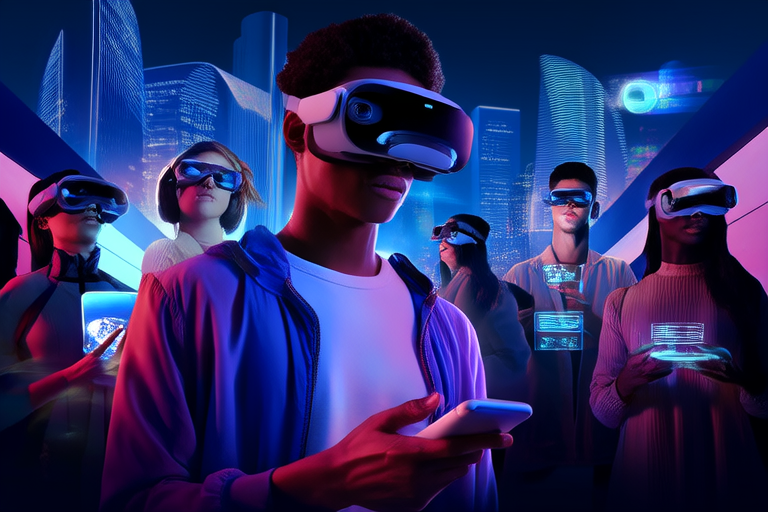

Immersive Experiences Await: Discovering the Boundless Possibilities of VR and AR
Introduction
Virtual Reality (VR) and Augmented Reality (AR) have emerged as transformative technologies, reshaping industries and redefining human interaction with digital content. These immersive experiences are no longer confined to niche markets but are increasingly becoming integral to various sectors, from education and healthcare to entertainment and retail. As VR and AR continue to evolve, they promise boundless possibilities, offering new ways to learn, heal, entertain, and engage with the world.
This article delves into the fascinating world of VR and AR, exploring their definitions, historical context, underlying technologies, and diverse applications. We will also address the challenges and future prospects, painting a picture of what lies ahead for these groundbreaking technologies.
Understanding VR and AR
Virtual Reality (VR) refers to computer-generated environments that simulate physical presence in places in the real world or imagined worlds. Users typically interact within this environment, usually through specialized headsets or equipment, which immerse them in a completely digital space. In contrast, Augmented Reality (AR) overlays digital information onto the real world, enhancing the user’s perception of their surroundings without fully immersing them in a virtual environment.
The journey of VR and AR began decades ago. Early attempts at creating immersive experiences date back to the 1960s, with pioneers like Ivan Sutherland developing the first head-mounted display. Over the years, significant milestones include the release of the Nintendo Virtual Boy in 1995, the introduction of the Oculus Rift in 2012, and the widespread adoption of AR apps like Pokémon Go in 2016. These advancements have been driven by improvements in sensor technology, display quality, and processing power.
The underlying technologies that enable VR and AR experiences include high-resolution displays, motion tracking sensors, haptic feedback systems, and powerful processors. These components work together to create realistic and responsive environments, allowing users to interact with virtual objects as if they were real.
Applications of VR and AR
Education
In education, VR and AR are revolutionizing learning environments. VR provides students with immersive experiences that can transport them to historical sites, outer space, or even inside the human body. For instance, students can explore ancient civilizations through interactive 3D models or conduct virtual experiments in a chemistry lab. AR enhances textbooks and classroom materials by overlaying digital information onto physical objects, making learning more engaging and interactive.
Healthcare
The healthcare sector has embraced VR and AR for training, therapy, and patient care. Medical professionals use VR simulations to practice complex surgeries, improving their skills and reducing errors. Additionally, VR is employed in pain management and mental health therapy, helping patients cope with chronic conditions and anxiety disorders. AR assists surgeons by providing real-time data and anatomical references during operations, enhancing precision and safety.
Entertainment
VR and AR are reshaping the entertainment industry, particularly in gaming, movies, and live events. VR games offer players immersive, first-person experiences, allowing them to step into the shoes of their favorite characters. AR enhances traditional gaming by integrating digital elements into the real world, as seen in games like Pokémon Go. In the film industry, AR and VR are used to create interactive movie experiences, where viewers can influence the plot or explore alternate endings.
Retail
AR is transforming retail by providing customers with virtual try-ons and interactive shopping experiences. Consumers can now visualize how furniture would look in their homes or try on clothes without physically visiting stores. This not only enhances customer satisfaction but also reduces returns and increases sales. Retailers are also leveraging AR to create personalized shopping experiences, offering tailored recommendations based on customer preferences and behaviors.
Real Estate
VR is being used to create virtual tours of properties, allowing potential buyers to explore homes remotely. This is especially useful in remote locations or during pandemics when in-person visits are limited. VR tours provide a realistic view of spaces, helping buyers make informed decisions. AR can assist real estate agents by overlaying property details onto the real world, giving clients a better understanding of the layout and features of a home.
Manufacturing and Engineering
VR and AR are invaluable tools in manufacturing and engineering, aiding in design, prototyping, and maintenance. Engineers use VR to create virtual prototypes, testing designs in simulated environments before physical production. AR assists technicians in performing complex repairs by providing real-time instructions and visual aids, reducing downtime and improving efficiency. These technologies also enhance collaboration among teams, enabling remote experts to guide on-site personnel through intricate procedures.
Challenges and Future Prospects
Despite their immense potential, VR and AR face several challenges. High costs associated with hardware and software development can limit accessibility. User experience remains a concern, with issues like motion sickness and discomfort affecting prolonged use. However, ongoing advancements in technology are addressing these challenges, leading to more affordable, comfortable, and intuitive devices.
Emerging trends include the integration of VR and AR with other technologies, such as artificial intelligence and the Internet of Things (IoT). These integrations promise to enhance functionality and interactivity, opening up new possibilities. Potential breakthroughs could include fully wireless VR headsets, advanced haptic feedback systems, and seamless AR interfaces that blend seamlessly with the real world.
Conclusion
From education and healthcare to entertainment and retail, VR and AR offer boundless possibilities across multiple sectors. These technologies are not just tools for innovation but catalysts for change, driving progress and enhancing human experiences. As we look to the future, the continued evolution of VR and AR promises even greater advancements, expanding their applications and transforming industries further.
With ongoing improvements in technology and increasing adoption rates, the future of VR and AR looks bright. These immersive experiences are set to become an integral part of our daily lives, offering endless opportunities for exploration, learning, and engagement.